Pestfacts Southeastern
 If you are spotting green peach aphid, Myzus persicae, you may be wondering if you should do anything about it. This aphid is a very efficient vector of turnip yellows virus (TuYV) after all; a plant virus known to cause economic damage in canola and some pulses.
However, green peach aphid is also very efficient at developing insecticide resistance and with many Mode of Action groups no longer useful for control, judicious use of remaining effective insecticides is crucial.
Here we discuss recent reports of green peach aphid, drawing upon the best available information to help answer your frequently asked questions.
Why is green peach activity higher than usual in areas?
Green peach aphid activity has been reported in young canola crops in several regions this season, particularly Victorian North Central and Wimmera regions.
There are two seasonal conditions which can help to explain increased green peach aphid activity in some regions:
Early season rainfall – Higher than average rainfall during late summer and early autumn would have created a reservoir of weeds, volunteers and alternate hosts for green peach aphid populations to develop and build up on in these areas.
A warm autumn – Autumn and spring are when we see peaks in aphid flights and activity with optimal temperatures for aphid population growth and movement. Autumn aphid activity and flights usually reduce during May with the onset of cooler temperatures. However, as May has been warmer than average this year, it’s likely why green peach aphid activity is higher than usual in some regions.
What’s the issue with green peach aphid during establishment?
Aphids can impact plants by direct feeding and/or through virus transmission.
In the case of canola and temperate pulses, the prime concern at establishment for many growers is the transmission of TuYV. It takes quite high numbers of aphids on an individual plant to warrant intervention for direct feeding damage alone; whereas TuYV transmission takes very few aphids per plant.
The green peach aphid is the primary vector of TuYV in Australia and affected crops can incur a yield penalty.
It is important to note that the outcome of TuYV infection is influenced by several factors including time of infection and growing conditions. See page 4 of the GRDC factsheet Manage turnip yellows virus in canola for further information.
How do I know if I have TuYV in my area?
While there are some symptoms of TuYV, the only reliable way to know if plants are infected is with pathology testing.
In canola, TuYV symptoms can include stunted growth, and red, yellow, or purple discolouration, particularly on the edges of older leaves. These colours are typically more intense between leaf veins and on the upper side of the leaf.
In pulses, symptoms often vary with crop type and can include yellow discolouration of leaves or plants and stunted growth.
However, infection in these crops can be symptomless and still cause yield losses. For example, a recent study showed no obvious symptoms of infection in lentils and field peas, however recorded reduced grain yield by 36% and 45% respectively, after early TuYV infection (Nancarrow et al. 2022).
What pulses are impacted by TuYV?
Fieldpea, chickpea and lentils can incur yield penalty from infection.
Lupins, vetch and lucerne are considered hosts of TuYV, however there is a lack of studies on whether the infection impacts grain yield.
While it has not been thoroughly researched, field observations suggest that TuYV has no to minimal impact on faba beans, with not all strains able to infect this crop (B. Congdon, pers. comm.).
Can other aphids spread TuYV?
Green peach aphid is not the only aphid that is found in canola and pulses in southeastern Australia, but it is the key vector of TuYV with an exceptionally high transmission efficiency of 96%.
Cabbage aphid and turnip aphid can be found in canola during early season growth, however they are not considered drivers of TuYV transmission in Australia (B. Congdon, pers. comm.).
In pulses, other species which can be found during crop establishment are bluegreen aphid, pea aphid and cowpea aphid. While little is known about their status as vectors of TuYV, they too are not considered drivers of TuYV transmission in pulses (B. Congdon, pers. comm.).
From a resistance management, sustainability and economic perspective, we don’t recommend spraying species other than green peach aphid to manage TuYV in canola or pulse crops.
How can I tell green peach aphid apart from other aphids?
In canola, green peach aphid can be mistaken for cabbage aphid and/or turnip aphid.
In pulses, green peach aphid can be mistaken for bluegreen aphid, pea aphid and/or cowpea aphid.
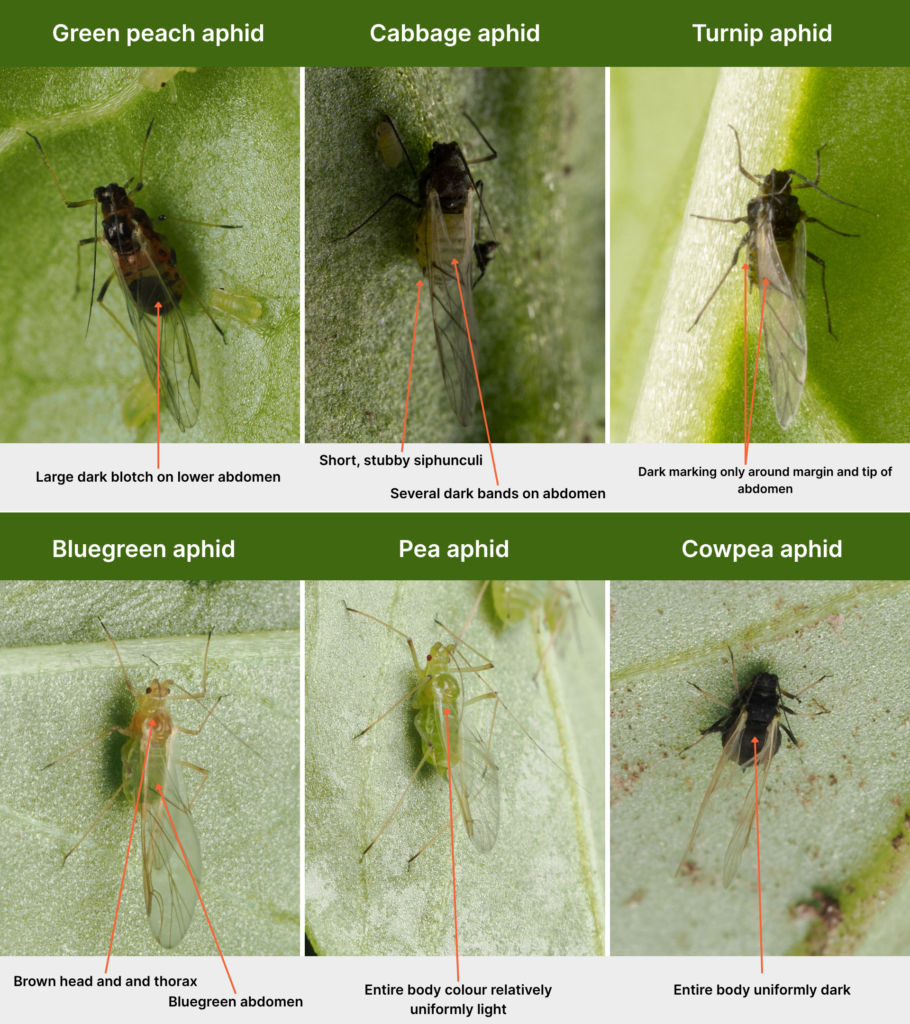
The wingless adult is the most suitable growth stage for aphid identification (Table 1 & Figure 1), though key distinguishing features for winged morphs are also provided (Figure 2).
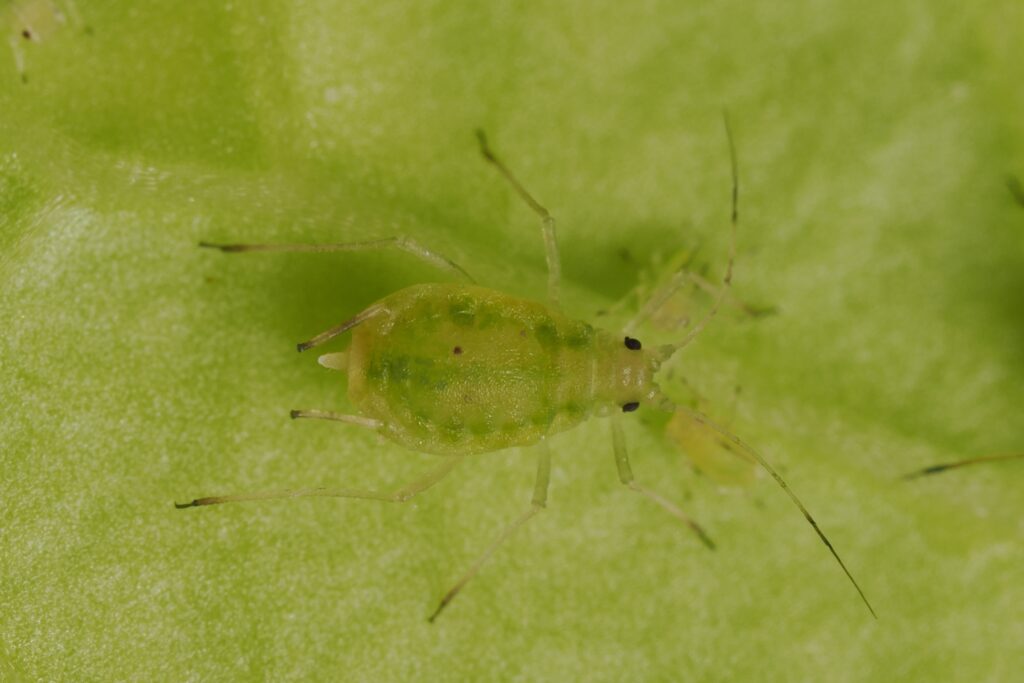
Green peach aphid, wingless adult. Photo by Julia Severi, Cesar Australia 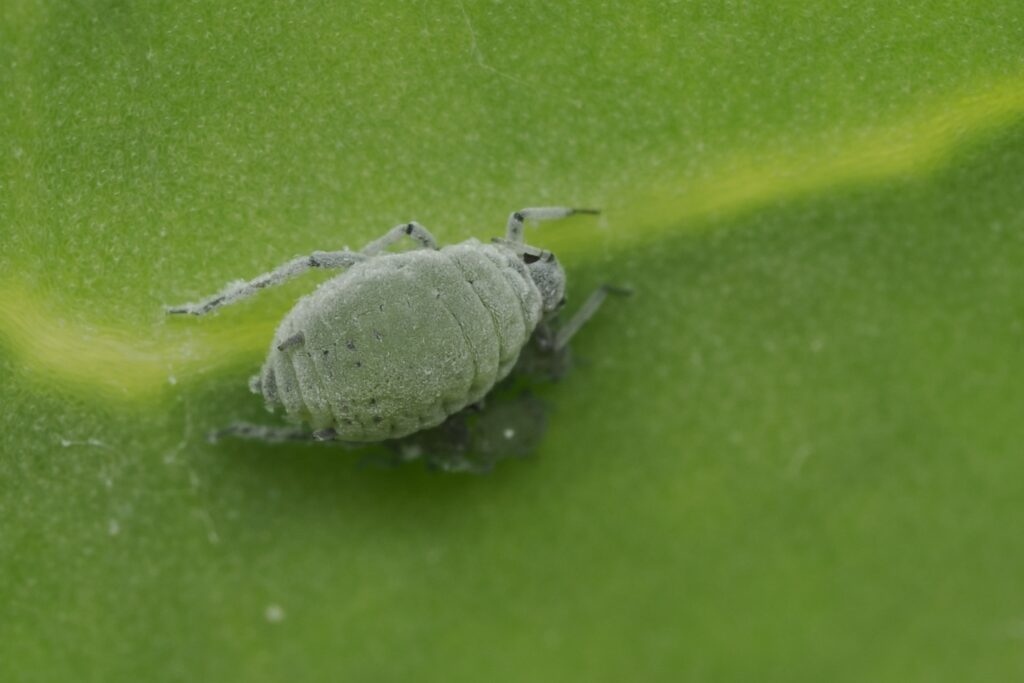
Cabbage aphid, wingless adult. Photo by Julia Severi, Cesar Australia 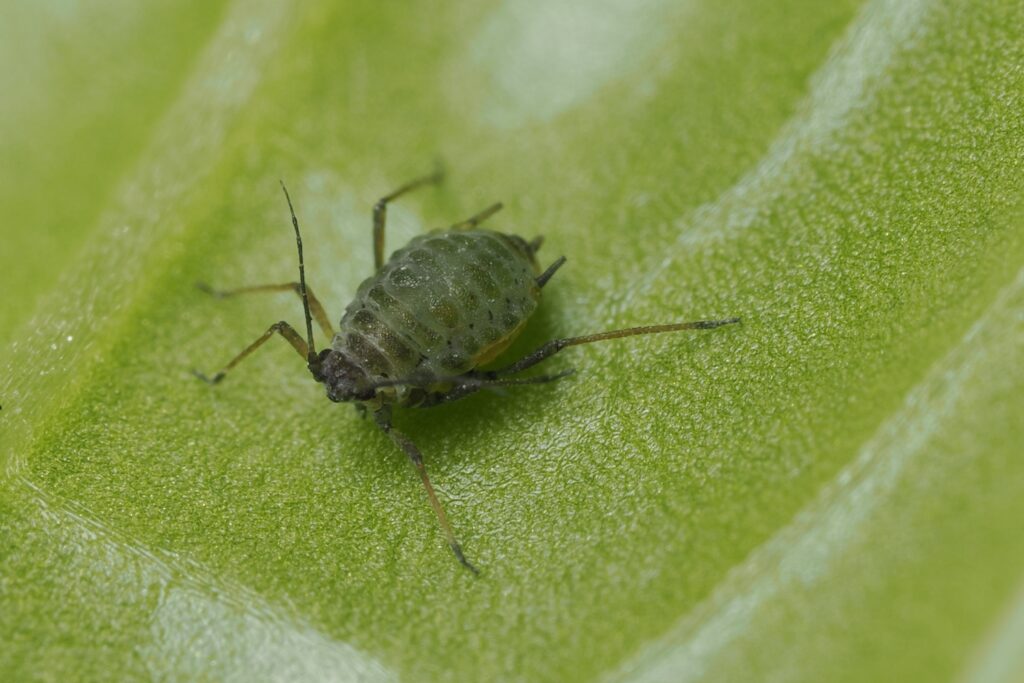
Turnip aphid, wingless adults. Photo by Julia Severi, Cesar Australia 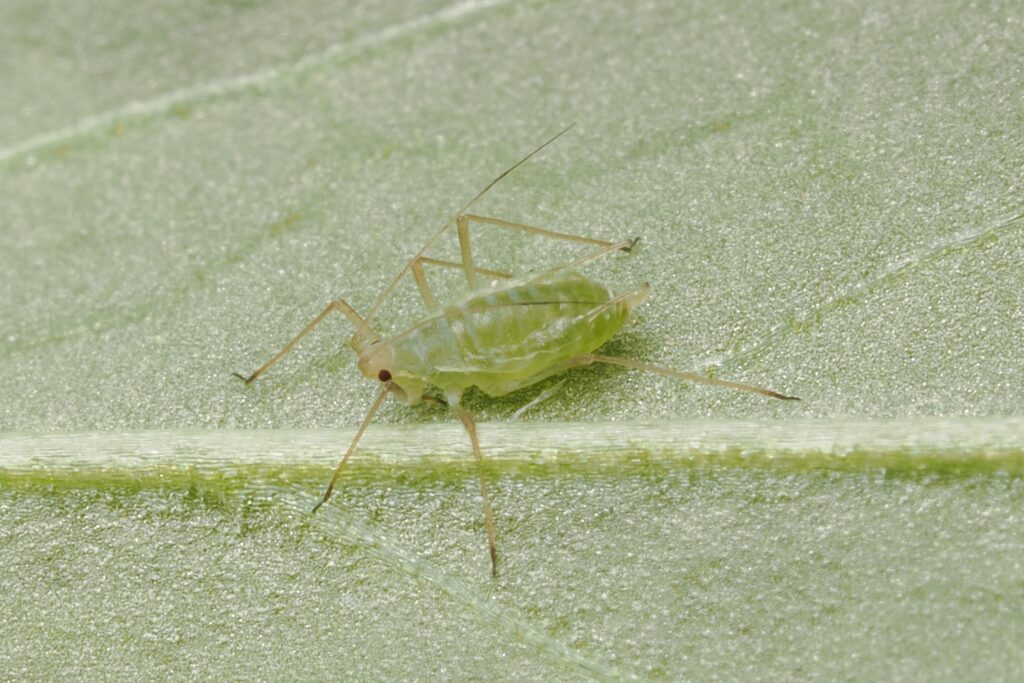
Bluegreen aphid, wingless adult. Photo by Julia Severi, Cesar Australia 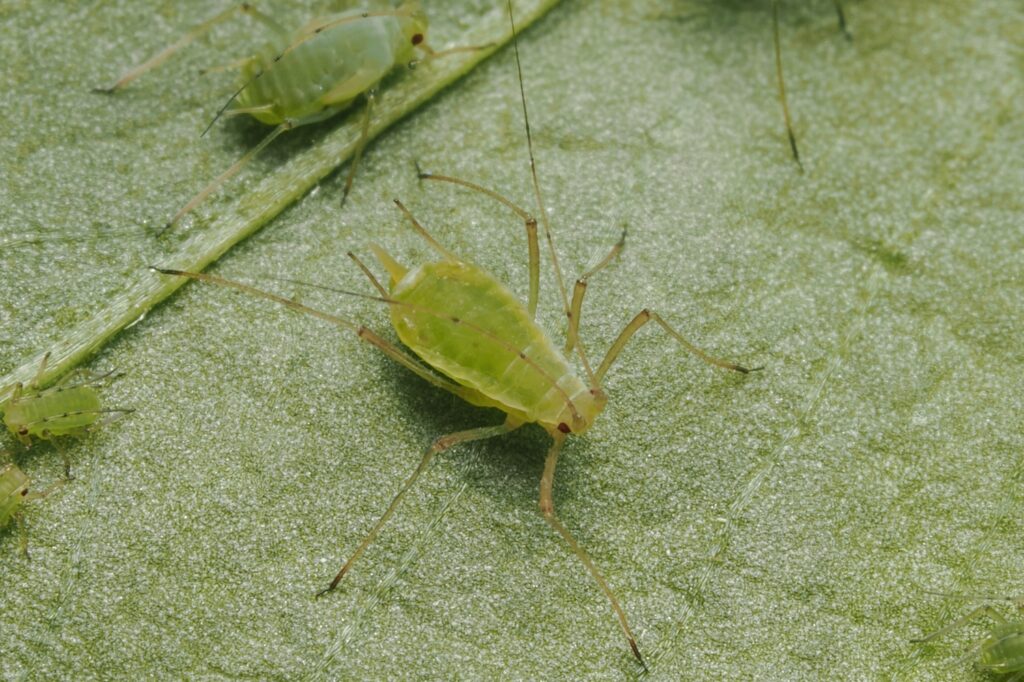
Pea aphid, wingless adult. Photo by Julia Severi, Cesar Australia 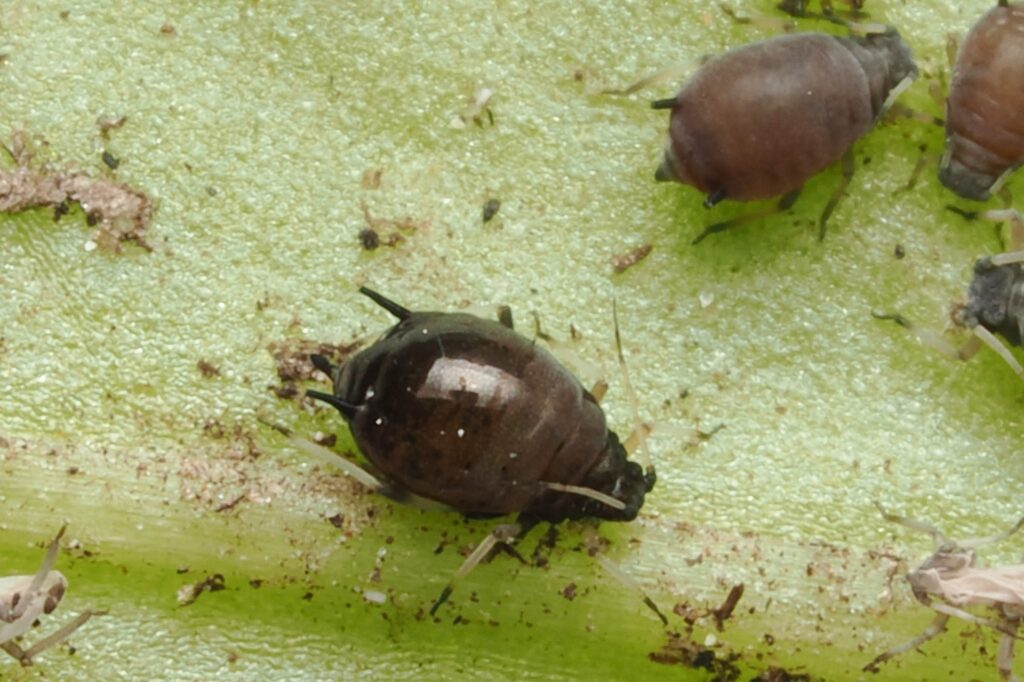
Cowpea aphid, wingless adult. Photo by Julia Severi, Cesar Australia
Table 1. Key features of wingless aphids in canola and pulses in southeastern Australia
| Species | Colour | Body surface texture | Distinguishing features |
| Green peach aphid | Green, yellow, pink, red, orange | Shimmery | Inward facing bumps between antennae (tubercules) |
| Cabbage aphid | Greyish-green | Mealy | Colony often covered in thick greyish-white wax Black transverse bars on abdomen Very short, stubby siphunculi |
| Turnip aphid | Grey, green or olive-green. Dark legs | Lightly coated with wax | Wax doesn’t evenly coat body, giving the appearance of two sets of darker bands running down their abdomen |
| Bluegreen aphid | Blue-green to grey-green | Dusty, matte | Colour and body surface texture |
| Pea aphid | Green, yellow, pink, red | Matte | The joints of antennal segments are dark |
| Cowpea aphid | Black (adults) Dark grey (nymphs) | Patent (adults) Matte, dusty (nymphs) | Their dark colour |
Do I need to spray for green peach aphid?
Spray decisions can be guided by the Green peach aphid – Best management practice guide, and Table 4, page 7, ‘GPA monitoring and insecticide application guidelines for TuYV control in canola’ in the factsheet Manage turnip yellows virus in canola.
What can I use to control green peach aphid in establishing crops?
In Australia, green peach aphid has evolved resistance to various insecticide Mode of Action groups common in foliar insecticides, including organophosphates, synthetic pyrethroids and carbamates. Some populations in WA, Qld, NSW, Vic and SA also have low-level resistance to sulfoxaflor (Transform™).
Where foliar insecticides are required to control green peach aphid in canola, we recommend applying a single application of flonicamid (e.g. Aria®, Mainman®), afidopyropen (Versys®) or sulfoxaflor. While resistance to sulfoxaflor is currently considered uncommon, it is now widespread in Australia. To ensure effective green peach aphid control in canola and help prolong the efficacy of sulfoxaflor, we recommend applying the product at the highest registered label rate.
If multiple sprays are needed, rotate between these products as part of a resistance management plan. For more information on best chemical practices, see the Green peach aphid – Best management practice guide. This guide includes a chemical windowing strategy, which has been developed by industry experts and endorsed by CropLife Australia.
With limited control options available in lentils, there is currently a minor use permit available for use of spirotetramat (e.g. Movento®) against green peach aphid in this situation. Some populations of green peach aphid in Australia have evolved resistance to spirotetramat and other insecticides within the same Mode of Action group. If spraying lentils, crops should be re-inspected 3–5 days after application to ensure aphid populations have been adequately controlled.
How many weeks protection can we expect from insecticide seed dressings?
Green peach aphid has also developed low-moderate resistance to neonicotinoids in Australia and recent research has confirmed that neonicotinoid-based seed treatments are no longer reliably controlling green peach aphid in canola.
That means growers can’t count on seed treatments alone to protect early crops from green peach aphid and TuYV.
For more information on this research see this 2026 paper from the GRDC updates.
According to A/Prof Paul Umina from Cesar Australia, widespread resistance to neonicotinoid seed treatments has significantly contributed to the increased incidence of green peach aphid in canola crops during autumn and early winter.
How do I get plants tested for TuYV?
Please contact your local state department of agriculture so plant pathology testing services:
Victoria – CropSafe, Crop.safe@agriculture.vic.gov.au, 03 5450 8301
New South Wales – Joop van Leur, joop.vanleur@dpird.nsw.gov.au
How can I see if green peach aphid has resistance in my region?
Cesar Australia is currently leading a GRDC-supported project involving surveillance of insecticide resistance in green peach aphid. Please see here for more information.
Acknowledgements
This article was authored by Julia Severi with input and editing support from A/Prof Paul Umina (Cesar Australia). Thanks to Dr Ben Congdon (WA DPIRD) and Narelle Nancarrow (Agriculture Victoria) for providing feedback.
Cover image: Photo by Julia Severi, Cesar Australia