Key takeaways
- Etiella behrii management involves targeting the adult moths before they lay eggs; larvae are burrow inside pods once hatched
- Use the SARDI degree-day model to plan moth monitoring
- Monitor with sweep nets and traps, and correctly identify moths before acting
- Use a threshold of 1–2 moths per 20 sweeps to guide spray decisions; keep monitoring until crops are desiccated, as later generations can still cause damage
Protection of susceptible legumes against Etiella behrii, aka the lucerne seed web moth, requires a unique strategy compared to most moth pests in grain crops.
The key difference is timing. Success depends on monitoring and if needed, management of the adult stage, not the caterpillar.
With spring just around the corner, here we outline the key steps for best practice management of Etiella behrii, including knowing when to start monitoring, how to identify adult moths, and thresholds for when chemical control may be warranted.
1. Check the Etiella behrii forecast
To stay one step ahead of Etiella behrii, use the SARDI Etiella degree-day model.
By tracking local temperatures from 21 June onward, this tool predicts when adult moths will take flight, helping you plan when to monitor.
It is recommended that monitoring begins at 300 degree-day accumulations.
Once the degree-day accumulations hit 351, we can expect about 10% of their flight activity to have begun.
Examples of degree-day accumulations between 21 June – 2 September in 2026 as calculated with SARDI Etiella Degree Day Model for some regions include:
Horsham (Vic) – 169
Swan Hill (Vic) – 206
Elmore (Vic) – 180
Wagga Wagga (NSW) – 208
Why is Etiella behrii management different to other moth pests?
Unlike many moth pests where control strategies target the caterpillars, Etiella Behrii is best managed by targeting the adult moths before they lay eggs, preventing the first spring generation of larvae from damaging grain.
As the weather warms up in September and October, adult Etiella behrii moths start emerging from their pupal stage after overwintering. Female moths will then lay their eggs in susceptible legume crops, including lentils, field pea, lupins and lucerne seed crops.
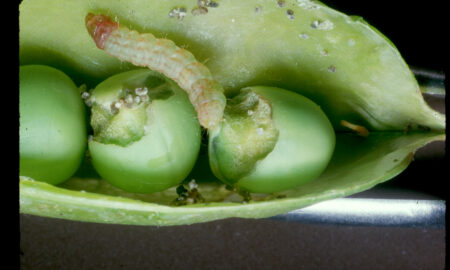
Within 24 hours of hatching, the larvae will burrow into plant pods, where they will feast and fatten themselves up on the developing grain. This can quickly reduce both yield and seed quality.
Sheltered inside the pod, the larvae are also protected from insecticides. The larvae won’t emerge from the pods until they are ready to pupate in the soil. By then, the damage to the developing grain has already been done.
2. Follow up with in-crop monitoring
The SARDI Etiella degree-day should not be used to enact a calendar-based or routine spray decision. Etiella behrii damage is not a given in every susceptible crop, every year, so in crop monitoring is essential before deciding whether control is needed.
Once your region reaches 300 degree-day accumulations, start monitoring green crops using a sweep net at least once a week. Dry crops aren’t at risk.
To monitor, take a minimum 3 sets of 20 sweeps, which each set taken randomly across different areas, within each crop. Sampling different areas, rather than in a single location in the crop, helps avoid basing a spray decision off a single hotspot.
Given the large scale of some paddocks, sweep-net monitoring can be supplemented with delta traps containing a pheromone lure. Etiella behrii pheromone lures are available for purchase through Dr Kym Perry (kymperry9@gmail.com, 0421 788 357).
3. Brush up on your Etiella behrii moth ID skills
Correctly identifying Etiella behrii is important before making a spray decision, as not every insect you find in the crop is a pest that requires control.
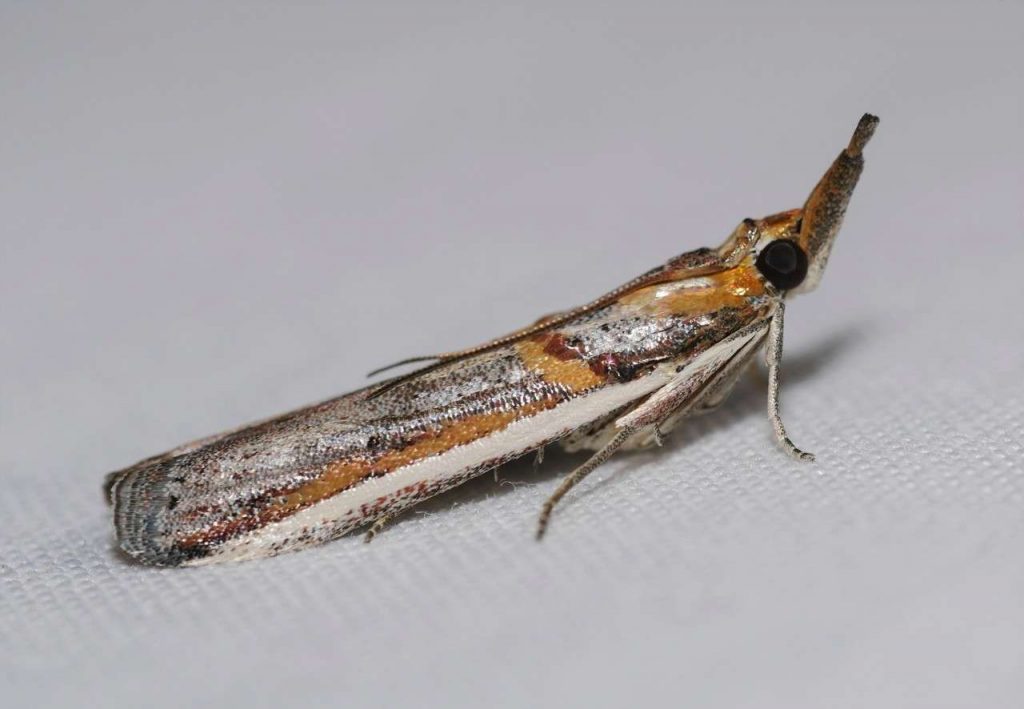
At rest, Etiella behrii moths are 10-15 mm long, slender in appearance with a snout-like beak.
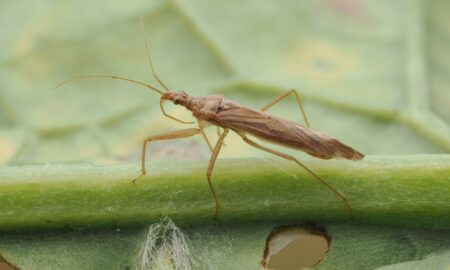
The challenge is that there are numerous other moth species that aren’t pests which can fit this description. Sometimes even beneficial damsel bugs mistaken for Etiella behrii.
To ensure what you are seeing is in fact Etiella behrii, look for the tan band that runs across the greyish-brown forewings and a white strip that runs the full length along the outer edge of the forewings.
4. Use thresholds and keep monitoring green crops
The recommended threshold for chemical control of Etiella behrii is 1-2 moths in 20 sweeps.
This chemical management strategy assumes the use of registered synthetic pyrethroid insecticides that have known efficacy against the moth stage.
Importantly, even after an initial insecticide spray in spring, continue to monitor while crops are green.
The first spring generation of Etiella behrii poses the greatest risk to winter legume crops, but the later generations can threaten crops that have not yet been desiccated.
More information
Etiella management in lentils, SARDI
Cover image: Photo by SARDI