Pestfacts Southeastern
 Key takeaways
- A TIMERITE® spray remains the most effective management strategy for reducing next season’s redlegged earth mite population numbers
- Before determining whether to spray, use a risk assessment based on the criteria outlined in the RLEM Best Management Practice Guide
- Spring spray dates are happening or approaching across southeastern Australia; visit TIMERITE® to check your dates.
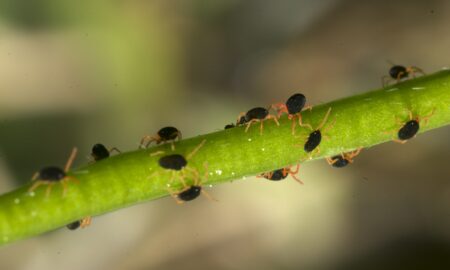
Are you experiencing high levels of redlegged earth mite (Halotydeus destructor, RLEM) this year? Are you planning on transitioning a paddock with RLEM from pasture to canola next year?
A TIMERITE® spray remains the most effective management strategy for reducing next season’s redlegged earth mite populations and may be worth considering for your property.
With best spray dates approaching across southeastern Australia, here we revisit how TIMERITE® works and how to access this important tool.
A bit about redlegged earth mite egg reproduction
During the hot, dry summer months, RLEM survive by producing diapause eggs. These diapause eggs are extremely resilient to heat and desiccation, allowing mite populations to persist into the next winter cropping season.
These eggs are produced during a specific window in late winter-spring.
Targeting the mites prior to the production of diapause eggs is a key strategy to reduce mite numbers in high-risk paddocks. Spraying after diapause eggs have been produced has little impact on next season’s mite pressure.
What is TIMERITE®?
TIMERITE® is a free online tool to help you pinpoint the optimal time to spray for RLEM in late winter-spring. It predicts the timing of diapause egg production, helping farmers apply control measures before this critical stage in the RLEM life cycle.
By controlling RLEM populations prior to diapause egg production the number of mites that hatch the following autumn is drastically reduced. This, in turn, protects emerging plant seedlings at a time when RLEM are most damaging.
The TIMERITE® strategy is based on the use of a long-term residual insecticide for control – for example, omethoate. Before determining whether to spray, conduct a risk assessment based on the criteria outlined in the RLEM Best Management Practice Guide (pages 7-8). Not all mite species produce diapause eggs in the same way and the TIMERITE® strategy exploits factors specific to the RLEM lifecycle. Therefore, it will not be effective at controlling other mite species.
Recent updates mean better results
TIMERITE® was recently updated with enhanced modelling that incorporates climate variability and changing climatic conditions. This change has shifted the recommended spray dates for many parts of southern Australia earlier by 27 days on average. This is expected to boost the effectiveness of RLEM control by up to 30 per cent.
To support more flexible on-farm decision-making, the updated TIMERITE® tool now provides both a ‘Best spray date’, which pinpoints the optimal timing for control, and a broader ‘Ideal spray window’, in which control of RLEM will remain at least 95% as effective as the optimum. This allows greater flexibility to perform chemical control in conjunction with suitable weather conditions or other farm operations, such as disease or weed control. TIMERITE® dates can change significantly over just a few kilometres and growers should check their specific postcode to be certain they have the most accurate information.
Check your TIMERITE® dates now
Best spray dates and windows are happening in some areas and are approaching soon for others.
If prompted by the RLEM Best Management Practice Guide risk assessment, check your spray dates at:
Acknowledgements
Updates and improvements to TIMERITE® were undertaken by Cesar Australia in collaboration with CSIRO, AWI, GRDC and Meat & Livestock Australia. This article was produced by Cesar Australia thanks to a GRDC investment in the project CES2503-001RTX Leading practice management of redlegged earth mite run in collaboration from WA DPIRD.
This article was compiled by Dr Aston Arthur and Ian Thomas with editing support from Julia Severi. The contents from the article were adapted from Revamped TIMERITE® delivers updated spray dates and improved control of redlegged earth mite.
Cover image: Photo by Andrew Weeks, Cesar Australia